



Rebellion has been in the air lately. No matter where you live in the country, we don’t think it is possible to be unaware of the protests, and the events that followed. Which is precisely why we feel like it’s important to talk about the spirit of rebellion. And how it helps us in surgery.
In September 1980, a gynaecologist in Kiel removed an appendix through a laparoscope.
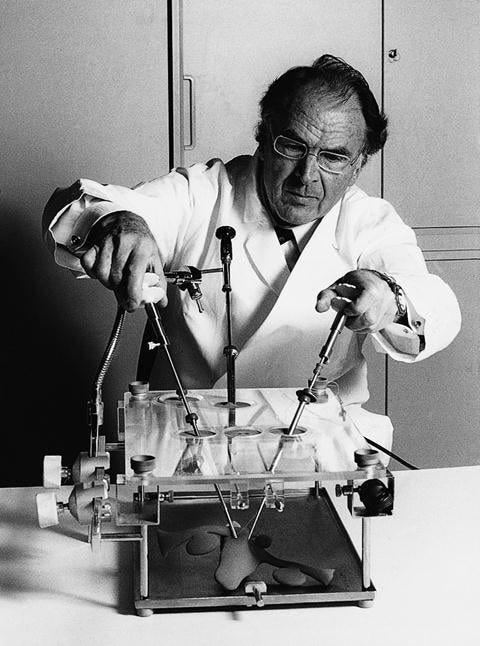
The response was not applause. After Kurt Semm lectured on what he had done, the President of the German Surgical Society wrote to the board of the German Gynaecological Society suggesting that Semm be suspended from the practice of medicine. He submitted his paper to the American Journal of Obstetrics and Gynecology and it was rejected as unethical.
His own summary of that period: every attempt to publish came back with the comment that such nonsense does not, and never will, belong in general surgery.
None of it can have surprised him much. A decade earlier, when he took the chair at Kiel, his own co-workers had asked him to undergo a scan of his head. They had reasoned that a man who operated this way might have brain damage. He went and had it done.
Five years after that appendectomy, in September 1985, Erich Mühe removed a gallbladder through a laparoscope using a device he had built himself and named the Galloscope.

He presented it to the Congress of the German Surgical Society in Munich in April 1986. They laughed at him — Mickey Mouse surgery, went one verdict; small brain, small incision, went another — and the society left his lecture out of the congress proceedings.
In 1992 the same society gave him its Anniversary Award, and its president described that operation as one of the greatest original achievements of German medicine in recent history.
We love these stories. We tell them at conferences, usually just before announcing something of our own.
And they are the most dangerous stories in surgery.
Let’s dive in.
The problem with heroes
We remember Semm because he turned out to be right.
There is no keynote lecture for the surgeon who deviated from the standard, was equally certain, equally dismissed, equally convinced that the establishment was protecting its own comfort — and was simply wrong. That surgeon exists. He exists many times over. He does not get a biography. His patients are a substantial part of the reason we now have ethics committees, consent forms, registries and audit.
Semm and the cowboy feel identical from the inside.
Both are certain. Both are dismissed by people they consider less imaginative than themselves. Both can point to a colleague who has told them they’re mad. Both believe, sincerely, that they are acting for the patient.
The subjective experience of being a visionary and the subjective experience of being a menace are the same experience.
Which means conviction is useless as a signal. It is the one instrument in the room that reads exactly the same whether you are Semm or whether you are the reason a family is sitting in a corridor at 2 a.m.
Let’s say the unpopular thing
If you are reading this and identifying with Semm, the base rates are against you.
Genuine innovators are rare. Surgeons who deviate from the standard for reasons that flatter themselves are not rare at all. And every single surgeon who has ever harmed a patient by going off-piste believed, at the time, that they were exercising judgement. Nobody scrubs in thinking today I shall be reckless.
But it take a different shapes, and you have seen all of them:
Operations that get extended because the surgeon could, not because the disease required it.
The technical modification performed forty times, and never once counted.
The “in my hands” defence — the claim that published complication rates simply don’t apply to you, offered without a single number to support it.
The technique picked up at a workshop on Saturday and performed on a patient on Tuesday.
The distinguishing feature between the innovator and the cowboy is not courage. Courage is cheap and it is distributed fairly evenly across the profession. The difference is process. Semm’s virtue was never his defiance. Any fool can be defiant. His virtue was that he kept publishing; which is to say, he kept submitting himself to the possibility of being proven wrong.
So if we can’t trust the feeling, we need a checklist. Here is ours.
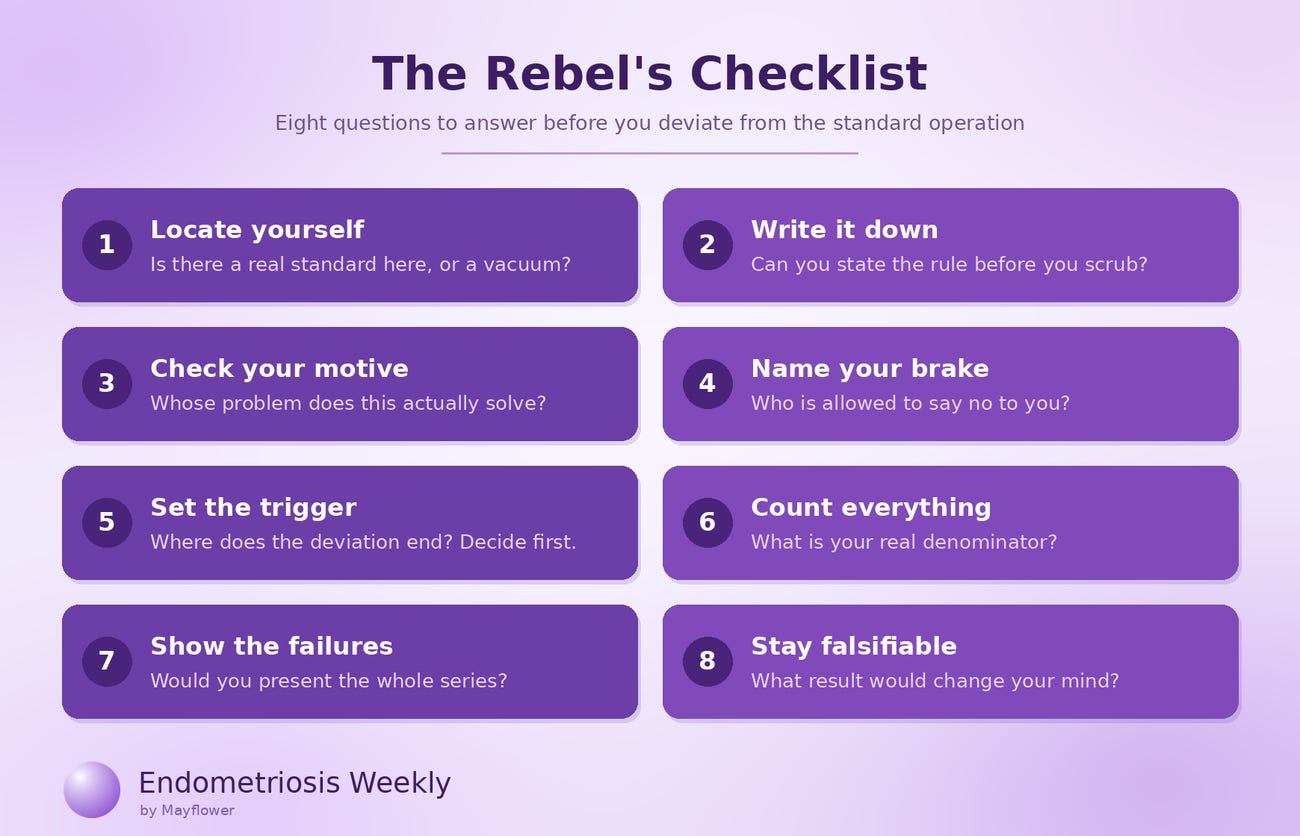
1. Is there actually a standard here to break?
There is a real difference between deviating from a clear, evidence-based guideline and making a decision in a space where the evidence is genuinely absent. The second one isn’t heresy. It’s the job. Endometriosis surgery is full of these vacuums, and thinking carefully inside a vacuum is not brave, it is the minimum standard of care.
Calling ordinary clinical judgement “innovation” inflates it, and inflation is how you skip the rest of this list. Ask which situation you are actually in. If a guideline exists and says otherwise, you have a much heavier burden than you think. If no guideline exists, you have a lighter burden and a duty to be honest that you are reasoning, not pioneering.
2. Can you write it down before you scrub?
This is the single most useful item here, and it is the one most often skipped.
A deviation you can state in advance, as criteria, as thresholds, in writing, before the patient is asleep, is a hypothesis. A deviation you can only explain afterwards, in the tea room, with your hands, is a mood.
The test is brutally simple. Before the case, write the rule. In patients with X, where Y is present and Z is absent, I will do A rather than the standard B, because of mechanism M, and I expect outcome O. If you can write that sentence, you are thinking. If you cannot, what you have is an urge with a vocabulary.
Write it down. Date it. Then you cannot quietly revise the plan after the fact to match what happened.
3. Whose problem does this solve?
Yours or hers?
Be honest about the whole list of things that make an unusual operation attractive: curiosity, boredom, the technical pleasure of a hard thing done well, the video, the abstract, the reputation, the wish to be the person in the region who takes the cases nobody else will.
Every one of those is a legitimate human feeling. Not one of them is an indication.
The question isn’t whether you have those motives — everybody does. It’s whether the operation would still be the right one if you stripped them all out.
4. Who is allowed to say no?
Name them. An actual person, with the standing and the temperament to stop you, told before the case rather than after it.
If there is nobody in your unit who can say no to you, you do not have a team. You have an audience. And an audience is the most dangerous thing a good surgeon can be surrounded by, because it removes the only external instrument that works when your internal one is broken.
This item has a second half, and it is not optional. The patient has to be told. Not in the abstract, and not buried in a form but told, in plain language, that what you are proposing is not the standard approach, why you think it is better for her specifically, and what the standard approach would have been.
If that conversation feels impossible to have honestly, that is diagnostic information about the plan, not about the patient’s intelligence.
5. What is your abort trigger?
Decided in advance. In specifics.
The rebel decides where the deviation ends before it begins. A trigger is a named finding that produces a named action: if this structure appears, if this plane refuses to open, if this measurement exceeds this number, I stop and I do the standard operation.
Without a pre-set trigger you do not convert. You drift. And drift is not usually discovered by the surgeon. Drift is discovered by the complication.
6. Are you counting?
All of them. Not the good ones.
Semm published. That is the whole difference. If you cannot state your own complication rate for the thing you are doing differently, a real numerator over a real denominator, including the cases that went badly, including the ones that went to another hospital, then you are not innovating.
You are experimenting without a logbook, which is a different activity with a different name.
7. Would you present the failures?
To a hostile room. With names of nobody but yourself.
This is the fastest test on the list and the one people fail most quickly, because it takes about four seconds to know the answer. Cowboys present their best case. Rebels present their series.
If the honest answer is no — if the thought of showing the whole run to a room full of people looking for holes makes you want to reach for the word “selected” — then stop. Not pause. Stop, and go back to item 6 until the answer changes.
8. Are you willing to be wrong?
Not “willing to be doubted.” Being doubted is easy and rather flattering; it is how the hero stories start, and every cowboy in the profession is enjoying being doubted right now.
Willing to be wrong. To discover that the thing you invented, named, taught and defended does not work; and to say so, in public, and stop doing it.
The cowboy’s real tell is not arrogance. It is unfalsifiability. Ask him what result would change his mind, and there isn’t one. Every good outcome is proof of the technique and every bad outcome is proof of a difficult case. Nothing can get in.
If you cannot name, right now, the specific finding that would make you abandon your own idea, you are not running a hypothesis. You are running a belief.
The trap on the other side
Everything above is aimed at the challenger. But the more dangerous position, statistically, is the one most of us reading this actually occupy.
Halsted’s radical mastectomy was not born as dogma. It was, in its time, the progressive, mechanistically reasoned, evidence-forward position — and it hardened into more than seventy-five years of orthodoxy that mutilated women who did not need to be mutilated. Breaking it took Bernard Fisher, a testable hypothesis that breast cancer was systemic rather than locally spreading, a randomised trial begun in 1971, and decades of follow-up. Fisher was not thanked promptly for this.
Read that sequence again, because the shape of it is the point: the rebellion won, and then the rebellion became the thing that needed rebelling against.
So the checklist does not only apply to what you are trying to start. It applies, with more force, to whatever you have already built and now defend. The technique you developed. The rule with your name attached. The protocol your unit is known for. Item 8 is hardest to run on your own invention, and that is exactly when it matters.
The moment you stop running this list on your own ideas, you are no longer Semm. You are the German Surgical Society of 1986 — well-intentioned, credentialled, and about to hand out an award forty years late.
This ought to sit particularly uncomfortably in our field. Endometriosis surgery is young enough that its standards are still setting. Which means a good number of the confident positions being taken today — including ours, including in this newsletter — are somebody’s dogma to break in twenty years. The only respectable response to that is to make our reasoning explicit enough to be attacked.
In Closing
Courage is not what separates the innovator from the menace. Both have plenty. What separates them is a written rule, a named dissenter, a defined stopping point, and a logbook nobody made them keep.
The romance of surgical rebellion is that it takes nerve.
It mostly takes paperwork.
That’s it for this week. See you in the next one.

