

The Habitable Pelvis
On cytoreductive surgery, hormonal reset, and why egg freezing deserves an earlier conversation


“Can she conceive?” isn’t a question to begin with when dealing with infertility. That question must come later, when time has already done some of its work. The question worth asking, at first consultation, when disease is mapped and surgery is being planned, is this:
What does she want her future to look like — and are we protecting it?
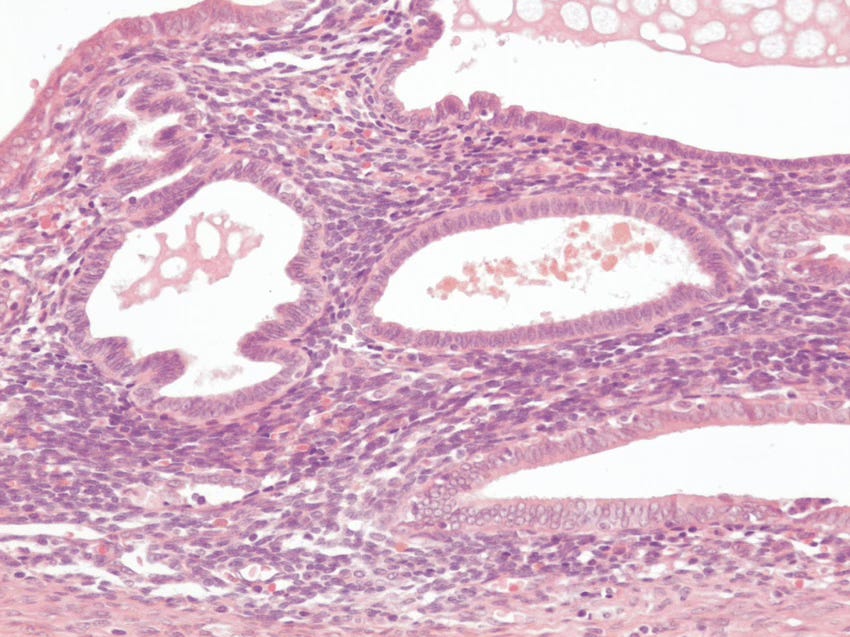
Endometriosis is not only a disease of pain. It is a disease of distortion. It distorts anatomy. It distorts the inflammatory milieu. It distorts the relationship between ovary, tube, uterus, peritoneum, ureter, bowel and bladder. And when fertility is at stake, either right now or later, every one of those distortions matters.
Conception isn’t magic. It is made up of a complex and fine balance between anatomy, biology, timing and environment, all working in unison for an outcome. When those elements are disrupted, the system fails.
This week, we want to make the case for a more proactive approach to fertility preservation in our patients: specifically, to egg freezing as a deliberate, strategically timed intervention.
The First Step: Proper Cytoreduction
For us, the most important principle in fertility-enhancing endometriosis surgery is complete cytoreductive clearance.
Not cosmetic clearance. Not partial clearance that removes the visible cyst and leaves the deeper disease. Not the kind of surgery that improves the laparoscopic view while leaving pathology behind.
A fertility-enhancing operation aims to remove disease from all relevant compartments:
Ureter and parametrium
Ovarian endometrioma, via careful cystectomy with preservation of the cortex
Tubo-ovarian adhesions — with full 360-degree adhesiolysis and restoration of anatomy
Diseased peritoneum, including butterfly peritonectomy
Rectal nodules
Torus uterinus and uterosacral nodules
Bladder disease
Uterine adenomyotic nodules, where adenomyomectomy is indicated
Any other involved pelvic compartment
The aim is not simply to “clean the pelvis” but rather to make the pelvis habitable again.
Why the Tubo-Ovarian Relationship Is the Pivot Point
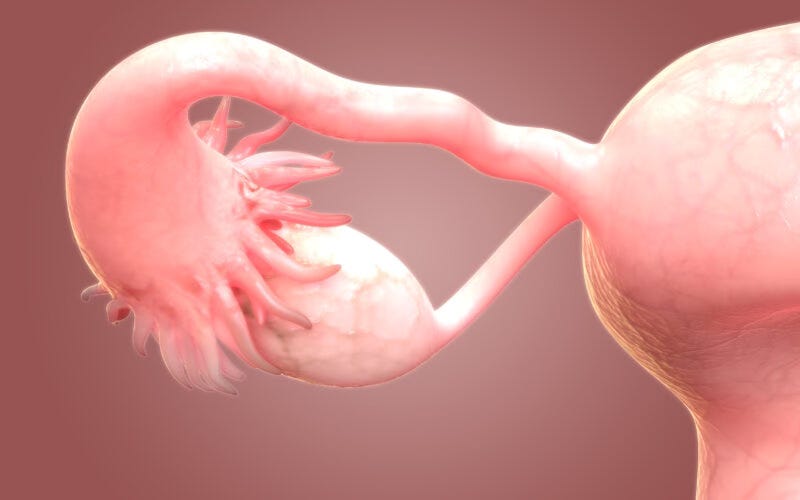
Surgeons focus rightly on the endometrioma. But the endometrioma is often only part of the problem.
In advanced endometriosis, the ovary may be tethered to the pelvic sidewall or the posterior leaf of the broad ligament. The tube may be retracted, kinked, or pulled away from the ovarian surface entirely. The fimbria — which needs to sweep across the follicular surface at ovulation to pick up the egg — may not be able to reach it.
Ovulation is still occurring hormonally. But mechanical hinderances make it hard for fertilisation to occur.
Pelvic adhesions and disrupted tubo-ovarian anatomy are recognised mechanisms of endometriosis-associated infertility, independent of ovarian reserve status. (Bulletti et al., J Assist Reprod Genet, 2010; Vercellini et al., Hum Reprod Update, 2014)
This is why adhesiolysis and restoration of tubo-ovarian anatomy are not optional extras. They are the mechanism by which natural conception becomes possible again. We have seen a natural conception rate of approximately 46% in our operated series, an outcome that reflects complete disease removal, restored tubo-ovarian anatomy, and a careful operative technique.
Individual results depend on age, ovarian reserve, sperm parameters, tubal integrity, disease stage, and previous surgical history.
The Ovary as an Environment
Consider an ovary with an endometrioma.
Inside and around it: old blood, inflammatory cytokines, oxidative stress, fibrosis, altered vascularity. The follicular environment is compromised in quality and so are the eggs maturing within.
Follicle density and premature activation. Kitajima et al. demonstrated that follicle density in the cortex of endometriotic ovaries is significantly lower than in the contralateral normal ovary, with the reduction correlating with cortical fibrosis — independent of prior surgery. (Kitajima et al., Fertil Steril, 2011) Subsequent work established the mechanism: endometriomas trigger excessive activation of dormant primordial follicles via the PI3K–PTEN–Akt–Foxo3 pathway, prematurely exhausting the reserve. (Takeuchi et al., J Clin Endocrinol Metab, 2019)
Measurable AMH decline. Across studies, women with endometriomas show lower AMH and reduced antral follicle counts compared to age-matched controls — with those carrying ovarian endometrioma and advanced-stage disease most affected. A prospective observational study further showed an accelerated rate of AMH decline in women with endometriomas compared to healthy controls. (Kasapoglu et al., 2018; Muzii et al., 2018; systematic review and meta-analysis: Reprod Biomed Online, 2020)
The surgical question is harder than it looks. Endometrioma removal, if performed imprecisely, can itself damage the remaining cortex — particularly with bilateral disease, large cysts, or repeated operations. Current evidence suggests that endometriosis affects the number of oocytes retrieved but not their intrinsic quality: when good embryos are obtained, IVF outcomes in these patients are broadly comparable to age-matched controls. The problem is quantitative, not qualitative. The reserve is reduced; the eggs themselves are not necessarily inferior.
This is a crucial distinction for our counselling. It means that getting eggs out early, before repeated surgery or progressive disease further reduces the pool, is a meaningful intervention.
The Reset: Postoperative Downregulation
After complete cytoreductive clearance, many of our patients receive postoperative hormonal suppression — typically a GnRH agonist for several months, depending on fertility timeline, age, disease burden, and symptom profile.
The framing here matters, because it is frequently misunderstood. We are not creating new eggs. Women are born with their ovarian reserve; no intervention changes that. What postoperative suppression does is quieten the endometriotic environment, reduce inflammatory drive, minimise early recurrence, and allow for the pelvis to heal after cytoreduction.
The evidence for this is honest in its limits. A Cochrane review found that long-term GnRH agonist therapy prior to IVF had uncertain effects on live birth rates, and an RCT of 400 patients with minimal-to-mild disease treated with GnRH agonists for three months post-surgery found no significant improvement in embryo quality, implantation, or clinical pregnancy rates. At the same time, GnRH agonist therapy post-surgery does reduce recurrence risk and endometrioma reformation — which has its own value for the patient who is not yet trying to conceive. The evidence supports postoperative suppression as a recurrence-reduction strategy; its role as a fertility-enhancement strategy is more contested.
What we can say with confidence is this: when hormones return after suppression, the pelvis is functioning in a cleaner, quieter environment. Less disease. Less inflammation. Restored anatomy. Better conditions for ovarian stimulation, better access for follicle development, and a clearer window for decision-making.
That window is worth acting on.
Why Egg Freezing After Surgery Can Be the Right Move
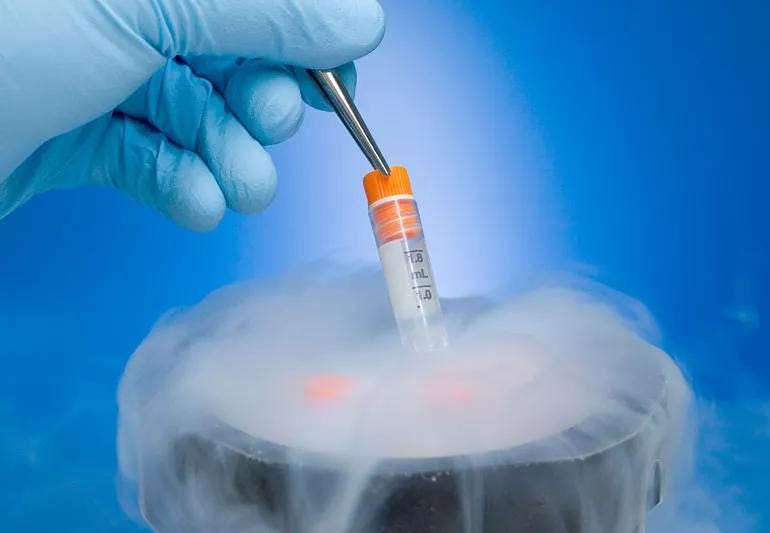
If a woman is not planning pregnancy immediately, either because she is unmarried, or because she is focusing on her career, in the middle of treatment, not ready, or simply wants to preserve options — egg freezing becomes an important conversation.
The case for it rests on several converging realities:
Disease burden has been reduced. The inflammatory environment that impairs follicular development has been addressed surgically. We are not stimulating through active disease.
Anatomy has been restored. Tubo-ovarian relationships are physiological again. The pelvis is accessible.
Ovarian reserve has not yet been further reduced. Every subsequent endometrioma, every repeat operation, every year of progressive fibrosis narrows the window. Freezing now preserves what exists now.
Oocyte quality is likely to be adequate. Endometriosis affects oocyte quantity, not intrinsic quality — IVF outcomes per retrieved oocyte are broadly comparable to age-matched controls. (Ata & Somigliana, 2024; Bartolacci et al., 2023; Gayete-Lafuente et al., 2024) Vitrification has significantly improved frozen oocyte survival rates, making cryopreservation a mature and reliable option. (Cobo et al., Reprod Biomed Online, 2021)
The patient has psychological space. Post-surgical recovery is often a period of relief and recalibration. Fertility decisions made in that window tend to be clearer than those made in the middle of uncontrolled disease.
The current literature identifies the strongest candidates for fertility preservation as: patients with bilateral endometriomas (typically >3 cm), those with prior surgery for a unilateral endometrioma who have ipsilateral or contralateral recurrence, and those with a single functioning ovary. (Chon & Jee, Clin Exp Reprod Med, 2024; La Marca et al., Hum Reprod Open, 2025)
Conversely, diminished ovarian reserve at the time of surgery complicates the picture and therefore stimulation in this group may not yield a meaningful number of oocytes, and the decision must be individualised.
Timing Must Be Individualised
We want to be precise here.
Not every patient should freeze eggs after surgery.
Some should try naturally; their anatomy is restored and their reserve is adequate.
Some should move directly to IVF.
Some may be better served by embryo freezing rather than egg freezing, if they have a partner and the relationship is stable.
Some have already started and the surgery was done to optimise an ongoing cycle.
There is no universal pathway.
There is only careful counselling, adjusted to the individual: her age, her ovarian reserve, her partner status, her disease history, her emotional readiness, and what she actually wants.
What we are arguing against is the implicit message that surgery is the end of the fertility conversation. For many patients, it is the beginning of the clearest possible fertility window they will have.
A diseased pelvis is a hostile environment.
A restored pelvis becomes habitable again.
The philosophy behind fertility-enhancing endometriosis surgery is not simply pain relief. It is the restoration of anatomy, biology, and possibility. And for the patient who is not ready for pregnancy today, egg freezing is not a concession to failure. It is a strategic act.
It is the decision to remain in control of the timeline.
We remove disease not only to reduce pain. We remove disease to restore possibility.
That’s it from us this week. See you in the next one.
 | A guest post by
|
 | A guest post by
|